
A worker who arrives at a trade test with an impressive-looking certificate and a strong CV can still fail in the first ten minutes on the bench. It happens constantly, and it isn’t because employers are being unfair — it’s because a certificate proves you passed a test once, somewhere, at some point. It doesn’t prove you can weld, lay block, or reverse a loaded truck today, on the specific task in front of you. Gulf employers know this, which is why they don’t hire off a CV alone. They hire off what a candidate can actually demonstrate.
At Al-Mojal International, we run candidates through trade testing before they are ever shortlisted for an employer, and the pattern is consistent across every trade: the workers who pass are not necessarily the most qualified on paper. They are the ones who prepared for the specific thing they knew they would be asked to do.
Certificates Get You the Interview. Skill Gets You the Job.
It’s worth being direct about this: a certificate is not disqualifying evidence if you’re weak, and it’s not a guarantee if you’re strong. Employers use certificates as a first filter to decide who’s worth testing — not as proof of ability. A 6G welding ticket, for instance, tells an employer that a candidate passed a specific test at some point, in some position. It says nothing about whether that candidate can produce a bead today that survives a bend test on the machine in front of them. If it can’t, the certificate doesn’t save the application. The test bench is the only thing that decides.
This surprises candidates who assume that once they’ve achieved a qualification, the hard part is behind them. In Gulf recruitment, the qualification is the entry ticket. The trade test is the actual interview.
What the Test Actually Looks Like, Trade by Trade
Every trade has its own version of “prove it,” and knowing exactly what will be assessed changes how a candidate prepares.
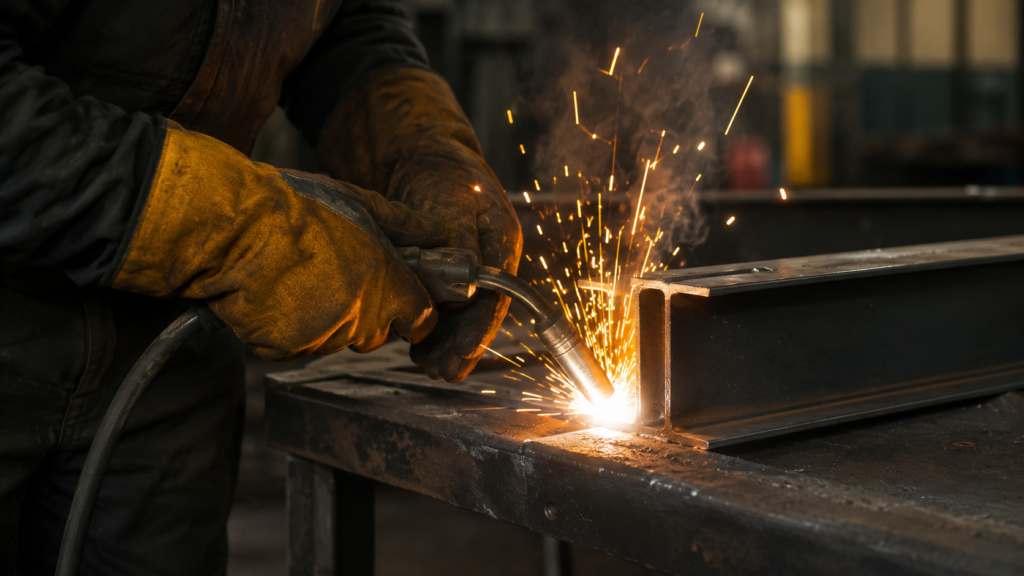
Welders are almost always tested in the specific position the job requires — flat, vertical, overhead, or pipe — because welding in one position does not transfer automatically to another. The weld produced is then usually subjected to a bend test, which checks whether the bead holds up under stress rather than just looking clean on the surface. A candidate who has only practised flat welding will struggle badly if the job — and therefore the test — calls for overhead work.
Masons are typically assessed on a plumb line and a straight, level course of blockwork, often within a set time. This sounds simple, but consistency under time pressure, using unfamiliar tools or materials, is where inexperienced or out-of-practice candidates lose marks.
Drivers, particularly for heavy vehicle or logistics roles, are commonly tested on practical manoeuvres like reversing a loaded vehicle into a tight yard or docking bay — a skill that has little to do with open-road driving ability and everything to do with recent, hands-on experience with a similarly sized vehicle.
Steel fixers are often tested on reading a reinforcement drawing and tying steel to the tolerances specified, not just tying steel correctly in general — the ability to interpret a real drawing under test conditions is part of what’s being assessed.
Electricians and technicians may be tested on troubleshooting a specific fault or completing a wiring task to a defined standard, rather than a general demonstration of electrical knowledge.
The common thread across every trade is the same: the test is never a general demonstration of “can you do this job.” It’s a specific, narrow task chosen because it reveals whether a candidate’s real-world experience matches what the job actually requires.
What Separates the Candidates Who Pass
After watching a large number of trade tests, three things consistently separate the candidates who pass from those who don’t.
They have worked recently in the trade. Skills that go unused for a year or more tend to soften, even for genuinely experienced workers. A candidate who worked steadily in their trade in the recent past performs more consistently under test conditions than one relying on experience from several years ago.
They bring their own basic tools where relevant. A tradesperson who shows up with their own trowel, level, or hand tools — rather than relying entirely on whatever is provided at the test centre — tends to work faster and more comfortably, because they’re using equipment they’re used to. It also signals to the assessor that this is someone who takes the trade seriously.
They have practised the specific task, not a general version of it. This is the single biggest differentiator. A welder who spent time practising the exact position the job calls for will consistently outperform an equally experienced welder who only practised whatever came easiest. Preparation that targets the actual test, rather than the trade in general, is what makes the difference on the day.
The One Question Every Candidate Should Ask Before a Test
If you are preparing for a trade test, there is one question worth asking your recruitment office directly: what, specifically, will be assessed? Not “what trade” — the exact task. Which welding position. Which type of blockwork. Which vehicle manoeuvre. Which fault type.
A licensed recruitment office that has properly read the employer’s demand letter should be able to answer this without hesitation, because the demand letter itself usually specifies the exact requirement the employer is hiring for. An office that can only tell you “it’s a welding test” or “it’s a driving test” without further detail either hasn’t read the demand letter closely, or is treating the test as a formality rather than the actual point of the process. Either way, that’s a sign to ask more questions before you invest time preparing for the wrong version of the task.
Prepare for the Test That’s Actually Coming
The difference between passing and failing a Gulf trade test is rarely about talent. It’s about whether a candidate prepared for the general idea of their trade, or for the specific task they were going to be asked to perform. Al-Mojal International tells every candidate exactly what will be assessed before they walk in, because we’ve read the demand letter, and because a candidate who knows precisely what’s coming has a real chance to show what they can actually do.
Browse current openings or talk to our team about what your trade test will involve before you prepare for it.
This article provides general guidance on Gulf trade testing practices. Specific test formats, tools, and standards vary by employer and by demand letter — confirm the exact requirements for your position with a licensed recruitment office before your test.
Hiring from Pakistan, or looking for work abroad?
One licensed office handles the demand letter, the shortlist, the trade test and the paperwork.